
National Science Fund – Ministry of Education and Science, Bulgaria

Methods for data generation, self-learning and model optimization in the lifecycle of AI tools in socially relevant domains
Overview
With the growing integration of artificial intelligence (AI)-based solutions into every area of our lives, it is essential to examine its underlying processes from a scientific perspective. A deeper understanding of the mechanisms underlying AI, especially large language models (LLMs), is critical to addressing their limitations, such as biases, lack of robustness, and the challenges of adaptability in dynamic environments. By adopting rigorous scientific methods, we can not only improve the accuracy and reliability of AI models, but also ensure that they are consistent with ethical standards and societal values. This research is of particular importance for the development of AI systems, which in the near future aim to be not only powerful, but also reliable, fair and accountable.
The current stage of AI shows remarkable advances in natural language processing and human-computer interaction. These models have demonstrated unprecedented capabilities in understanding and generating human-like text, leading to widespread application in a variety of fields, from automated query response systems to sophisticated research tools. Despite these achievements, significant challenges remain. LLMs can inherit and even reinforce social biases embedded in their training data, leading to distorted, unethical or even harmful outcomes, such as racist remarks, misinformation or the reinforcement of stereotypes. Furthermore, the real-time adaptability of these models, their ability to function effectively in multi-agent systems, and their consistency with human preferences remain critical areas for active research and future studies.
To overcome these challenges and fully exploit the potential of AI, we need to adopt a systematic and scientific approach. This includes the detailed study and refinement of AI models, the development of robust and diverse datasets, and the application of advanced fine-tuning and optimization techniques. A deep understanding of the underlying processes of AI at a scientific level can lead to the creation of models that are more resilient, adaptive, and able to function in complex, dynamic environments. In addition, this approach opens up opportunities to create innovative methods to assess and reduce bias, ensuring that AI systems are not only fair and inclusive, but also able to detect and counter issues such as racism, misinformation and other forms of harmful content.
Team
- Coordinator of the Research Team Prof. Dr. Tatiana Atanasova IICT-BAS
- Prof. Dr. Desislava Ivanova Technical University of Sofia
- Assoc. Prof. Dr. Kristina Dineva IICT-BAS
- Dr. Plamen Petrov IICT-BAS
- Dr. Viktor Danev IICT-BAS
- Velizar Varbanov IICT-BAS
- Kalin Kopanov IICT-BAS
Work Packages & Roadmap
Stage 1 – Successfully Completed
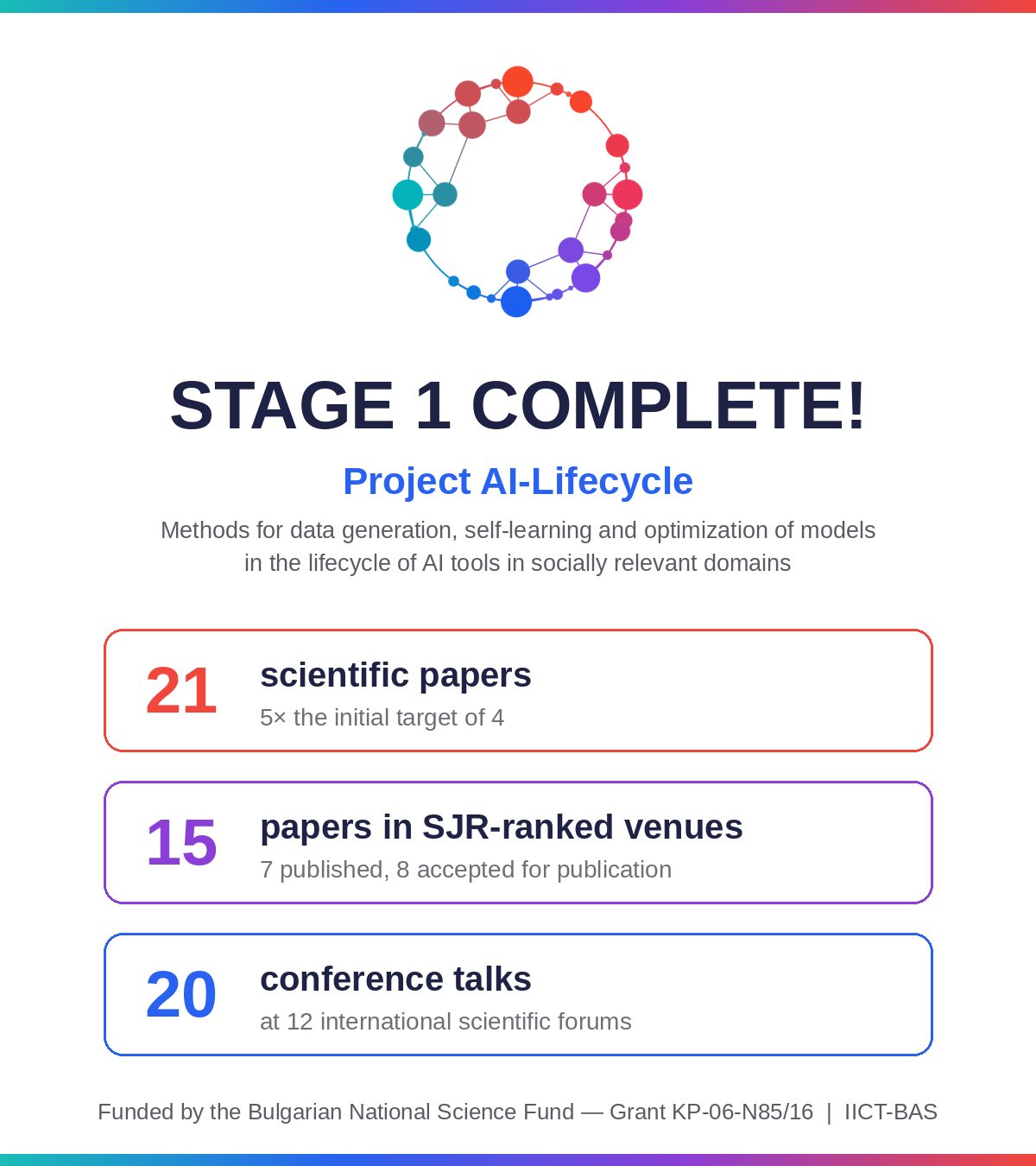
The project has successfully completed its first stage (18 months), covering the activities under WP1, WP2, WP3 and WP6. Against a target of 4 scientific papers for the stage, the team delivered 21 – more than five times the plan – including 15 in SJR-ranked venues, and presented 20 talks at 12 international scientific forums. The Stage 1 scientific report was submitted to the Bulgarian National Science Fund in July 2026.
Key scientific outcomes include new methods for synthetic data generation, approaches for bias evaluation and mitigation, methods for attribution of AI-generated text (including quantum SVMs executed on the HEMUS supercomputer), hallucination audits of large language models, and efficiency benchmarks of small language models on edge devices.
Publications & Results
In SJR-ranked venues
- Varbanov, V., Atanasova, T. Improving Industrial Control System Cybersecurity with Time-Series Prediction Models. Engineering Proceedings, 101(1), 4, MDPI, 2025, ISSN:2673-4591, DOI:10.3390/engproc2025101004.
- Kopanov, K., Atanasova, T. A Comparative Pattern Analysis of Qwen 2.5 and Gemma 3 Text Generation. WSEAS Transactions on Information Science and Applications, 22, WSEAS Press, 2025, ISSN:2224-3402, DOI:10.37394/23209.2025.22.50, pp. 604–615.
- Dineva, K., Atanasova, T., Varbanov, V. Analysis of Data Fragmentation in Artificial Intelligence Models to Improve Decision-Making Processes in Socially Significant Areas. International Multidisciplinary Scientific GeoConference SGEM, 25, 2.1, SGEM, 2025, ISBN:978-619-7603-89-7, ISSN:1314-2704, DOI:10.5593/sgem2025/2.1/s07.03.
- Dineva, K., Atanasova, T., Kopanov, K. Data Collection Methodology for Artificial Intelligence Models in Socially Relevant Areas. International Multidisciplinary Scientific GeoConference SGEM, 25, 2.1, SGEM, 2025, ISBN:978-619-7603-89-7, ISSN:1314-2704, DOI:10.5593/sgem2025/2.1/s07.02, pp. 13–18.
- Varbanov, V., Atanasova, T. Renewable Energy Infrastructure: Vulnerability Mapping and Predictive Risk Modeling. 25th International Scientific Multidisciplinary Conference SGEM 2025, 25, 4.1, SGEM, 2025, ISBN:978-619-7603-83-5, ISSN:1314-2704, DOI:10.5593/sgem2025/4.1/s16.18, pp. 141–150.
- Dineva, K., Atanasova, T. Green Energy and Digitalization: A Theoretical Perspective on the Role of Decentralized Technologies. International Multidisciplinary Scientific GeoConference SGEM 2025, Vienna, 25, 4.2, SGEM, 2025, ISBN:978-619-7603-93-4, ISSN:1314-2704, DOI:10.5593/sgem2025v/4.2/s20.81, pp. 741–748.
- Dineva, K., Atanasova, T. A Cloud-Based Architecture for Automated Data Extraction and Integration from Multiple Government Sources. International Multidisciplinary Scientific GeoConference SGEM 2025, Vienna, 25, 4.2, SGEM, 2025, ISBN:978-619-7603-93-4, ISSN:1314-2704, DOI:10.5593/sgem2025v/4.2/s21.96.1, pp. 883–890.
In refereed venues indexed in international databases
- Staykov, B., Atanasova, T. Smart Control System for Photovoltaic Power Plants. 23rd Industrial Simulation Conference ISC’2025, Skövde, Sweden, EUROSIS-ETI, 2025, ISBN:978-9-492859-35-8, pp. 67–70.
- Petrov, P., Atanasova, T. Enhancing Students’ Communication Skills with AI-Powered VR Soft Skills Training. 23rd Industrial Simulation Conference ISC’2025, Skövde, Sweden, EUROSIS-ETI, 2025, ISBN:978-9-492859-35-8, pp. 48–51.
- Kopanov, K., Atanasova, T. Evaluating Semantic Preservation in Multilingual Round-Trip Translation. 39th European Simulation and Modelling Conference ESM’2025, Ghent, Belgium, EUROSIS-ETI, 2025, ISBN:978-9492859-38-9, pp. 87–94.
- Atanasova, T., Danev, V., Dineva, K. Integrating AI into the Energy Transition Towards Renewable Energy Sources. 10th International Conference on Energy Efficiency and Agricultural Engineering EE&AE 2025, Stara Zagora, Bulgaria, IEEE, 2025, pp. 1–6, DOI:10.1109/EEAE65901.2025.11273792.
Accepted for publication
- Danev, V., Muchanova, V. Optimizing Workflow in Industry through the Internet of Things and Artificial Intelligence. 51st International Conference “Applications of Mathematics in Engineering and Economics” AMEE 2025, accepted for publication.
- Petrov, P., Atanasova, T. Integrating AI-Generated 3D Models into Education – A Methodological and Practical Approach. 51st International Conference “Applications of Mathematics in Engineering and Economics” AMEE 2025, accepted for publication.
- Varbanov, V., Atanasova, T. Detecting Information Operations Using Machine Learning Algorithms. 51st International Conference “Applications of Mathematics in Engineering and Economics” AMEE 2025, accepted for publication.
- Kopanov, K., Atanasova, T. Degradation of Stylometric Attribution Accuracy for AI-Generated Text. 51st International Conference “Applications of Mathematics in Engineering and Economics” AMEE 2025, accepted for publication.
- Dineva, K., Atanasova, T. Comparative Analysis of LLM, LRM, and DRM Models for Building an AI Agent in Socially Relevant Domains. XXVI International Multidisciplinary Scientific GeoConference SGEM 2026, July 2026, SGEM, ISSN:1314-2704, accepted for publication.
- Dineva, K., Atanasova, T. From Model Selection to System Design: Architectural Foundations for AI Agents in Knowledge-Driven Systems. XXVI International Multidisciplinary Scientific GeoConference SGEM 2026, July 2026, SGEM, ISSN:1314-2704, accepted for publication.
- Kopanov, K., Atanasova, T. Scaling Quantum Support Vector Machines for AI-Generated Text Attribution: Dimensionality, Shots, and Linguistic Feature Insights. ICAMCS 2025 – 5th International Conference on Applied Mathematics & Computer Science / WSEAS Transactions on Information Science and Applications, ISSN:1790-0832, accepted for publication.
- Kopanov, K., Atanasova, T. Distinguishing Lexical Deviation from Semantic Resilience in LLM-Based Round-Trip Translation. New Trends in Computer Sciences, 2026, eISSN:2783-6851, accepted for publication.
- Danev, V. Using Generative AI in Psychotherapeutic Practice – Technological Evolution and Paradigm Shift in Mental Health Care (in Bulgarian). XXV International Scientific Conference “Applied Psychology and Social Practice”, June 2026, Varna Free University “Chernorizets Hrabar”, Varna, Bulgaria, accepted for publication.
- Kopanov, K., Atanasova, T. Hallucination Without Abstention: Auditing Qwen 3.5 on SimpleQA. Studies in Computational Intelligence, Springer Nature, ISSN:1860-949X, eISSN:1860-9503, accepted for publication.
Resources
Details will be added soon.